

The History of Depression
It doesn’t matter if you have depression or not, we all face stress on a daily basis and what matters is how we handle them. It is also significant what time of the day the stressor comes and attacks you. Earlier on you have more energy and self control to combat it, later in the day, especially if you have more problematic people and situations to deal with you get depleted and you get more reactive. These stressful events will fuel your sense of losing self-worth and self esteem and with other factors can add to depression.
Today I am going to talk about the historical roots of depression. We are going to visit our ancestors 2000 generations ago as well as 400 generations ago, when warfare came to being. Then we will jump further ahead in time and see how slavery, serfdom and later the industrial revolution changed our mental health and how we have been trying to cope with all the accelerated lifestyle since then.
You might think to yourself going back tens of thousands of years ago again? Isn’t it an overkill? Why do I have to know how cavemen lived when I just want to improve my life today? We are so much smarter, surrounded by technology and we live so differently that nothing really could be comparable! I would disagree with you. The average individual had to know a lot about the surroundings to survive, about all the plants and trees, which was toxic, which part was edible if it was at all, about the habits of animals, how to make tools. Every one of them needed to know that and needed to pass on all their knowledge to their children. And just as you fill out a form about your family’s medical history, where it is useful to know if anybody before had cancer, cardiovascular disease or mental illness, these kinds of genetic traits go back to tens of thousands of years ago. We know for example that schizophrenia was much more common in paleolithic times and it can completely disappear from our genome in the future.
So I think first we need to start with the genetic factor of depression. Scientists believe that as much as 40% of cases can be traced back to genetic links and the rest is environmental. So if that is true, our ancestors 50,000 years ago must have had the same genetic traits and suffered from depression. But how could they have survived then? They would have been unable to look for food or develop tight social bonds which was critical for survival. At times they were under tremendous stress when they hunted down a large animal or faced famine. Just imagine yourself in your tribe collecting fruit, vegetables in the summer, you all fill your tummy because you can’t preserve any of these and naturally you gain weight. But you can collect nuts and seeds and carry that with you for winter days when there is nothing else but what hunting gets you. And that might not happen as easily as you would like it to be. It is dangerous and you have to cover a large area to find large animals that would feed all of you. Meantime you all can go hungry for days at a time. But you are used to that by now. This is why your weight fluctuates between summer and winter. You are using your reserves when there is nothing to eat. Famine is just as much part of your lives as accidents and deaths of your children and your peers. You deal with it together as a tribe, and go on. You all provide each other with the much needed support to heal. You have developed your rituals, chanting and dancing to help your mental healing.
Now let me pause for a moment and introduce four terms that will be crucial in discussing depression today.
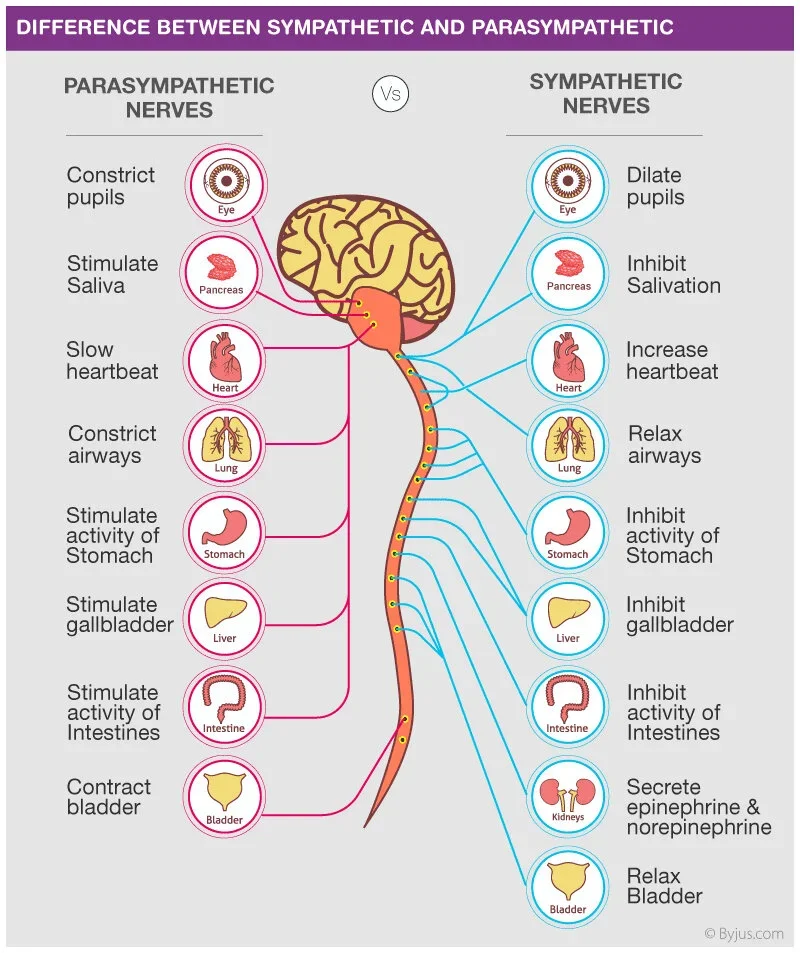
Words for today are acute, meaning that something happens one time and we are aware of the cause, with acute pain you know what caused the pain, like when you break your arm for example. After healing the pain will subside, with acute stress, after the stressor is eliminated, everything goes back to normal. I could play with words and say that the accumulation of acute is chronic, when we have no idea what the cause would have been, for example we can’t trace back our persistent back pain that has been so bothersome for over six months for any specific event, or chronic stress, when we are under constant alert but we cannot really understand why we cannot relax anymore. Another pair of words is sympathetic and parasympathetic. Four words that make or break our mental or physical state.
You might remember the autonomic nervous system from your biology class. It is an involuntary system that works two ways. The way you can remember it easily if you imagine our ancestors hunting and a saber tooth tiger turns around and wants to catch them instead. Now the sympathetic nervous system shows sympathy for the feelings of our ancestors’ fright and fear, and they have three choices. They can fight the tiger, they can flee the scene quickly, that is the flight response, or freeze, pretending they are already dead. Their sympathetic nervous system feels their pain and helps them focus all their energy to get out of this dangerous place. Their pupils dilate, there is no more saliva production, bronchi are dilated in the lungs, heart is accelerated, glucose release is stimulated, stomach, pancreas and intestines are inhibited along with urination among other things. Their body is ready to give its fullest to the task, thanks to this nice and sympathetic nervous system. When the danger passes, maybe some of the pumped up mates kill the tiger, so this acute, situational stress is gone, the body can relax and the nervous system can go beyond the sympathetic phase, and the so called parasympathetic or beyond sympathetic nervous system takes over. Now it constricts pupils, stimulates saliva and tear production, constricts bronchi in the lungs, slows the heart down, stimulates the stomach, pancreas and intestines along with urination and sexual organs come back to normal. Acute stress, acute danger, acute response, done, over with, now they can relax and enjoy the day. Our ancestors can get back to normal and seize the day.
See, they had to deal with each stressor, each situation right there, head on. Nothing could wait, there was no time to procrastinate or delay because that had a deadly outcome. They did not dwell on the past. What if I had done something differently, or dwell on the future, what if it will happen again? Of course, they would hunt again, tribe members would die again, babies were vulnerable, so were mothers. This was reality and they had ways to deal with reality together.
In modern times we have this tendency of overthinking and mixing past, future and negative images together. Our depression becomes chronic, which means that it lingers on for years without us being able to do anything about it other than get a prescription. It is called learned helplessness, when we think we have no power over events and our own lives. We become passive and feel we cannot do anything to relieve our suffering. Can we learn from our grandparents 2000 generations ago? We need lifestyle patterns, not just as individuals but as families and communities to deal with situations. They had rituals, but outside churches we don’t have them anymore. These can be conscious habits and regularly scheduled events when we get together and remember our loved ones who passed instead of ignoring that fact, giving support to the ones who suffer from major illnesses instead of ignoring them, Sharing something uplifting. Show real affection and care.
In this feel-good superficial society we feel we always need to hide behind a fun looking mask, otherwise we will not be accepted. And unfortunately sometimes it is true. People don’t have enough time for us if we are in trouble. But most of us just want to show real emotions and receive the same, we just don’t know how to communicate this desire.
Our ancestors didn’t have this problem. If they felt frustrated, they showed frustration. When they felt joy, they showed it. And when they felt sadness, they were not afraid to show that either. They did not accumulate stress, they developed social rituals to cleanse themselves and rid their minds from sadness and pain. They dealt with death on a weekly basis. Children's mortality rate was high, mothers might have died after giving birth to multiple children. They did not die of old age. Accidents were common. So they faced dangerous situations and stressors but they had their tribe to lean on. So depression probably did not last long and never went as far as becoming full blown paralyzing clinical depression. They were outside, they moved a lot, they ate a variety of seasonal food. Some psychologists think that depression in that sense doesn’t need to be considered an illness, it is on a spectrum of contemplation, wanting to isolate and think deeply about a problem. In some critical situations depressed people can find better solutions by giving time and running different scenarios through their heads. It may have been that some life changing decisions were made by these melancholic people in prehistoric times too.
Some food also caused inflammation in the body even at that time and that led to depression so at that time they could use that time to hide away and give their body some rest. Up until today food can alter mood too.
About 400 generations ago kings started to rule over people and were supported by priests validating subjugation by telling people that the king was chosen by god. Warfare came about this time, especially when sedentary people who started to farm and had some reserves were invaded by nomads who wanted to get those reserves for themselves. At that time land, plants, animals, became property and soon the need of proper inheritance arose.
I think socially and environmentally induced depression started at that time with social inequality and ownership over women and children. Later with warfare bounty included enslaving the enemy as well. This notion is arching over into our society even today slavery affects millions of people. They fight, they go through the stages of grief over their loss of freedom. But we just don’t know how people feel who were born into slavery. Would they just give up. give in and accept as something they would never be able to change?
Serfdom in the middle ages is similar to slavery. They didn’t own the land they worked on and they had to pay the landlord, the king and the church before they fed their families. There was no light at the end of that tunnel, no way they could escape that life. They were born peasants and their grandchildren would have been peasants too. I don’t think they could ever describe their depression but it must have been a bleak outlook for life. At least they had their family and community. Their wives were in the same boat, they all worked from early morning to late at night on the fields and with the animals. They told stories and they cared for their children and the old. They had each other, so overall they might not have seen their own lives as bleak and depressive, it was more balanced and reliable for them. Reliable in the sense that they knew what would happen the next day, who to call when someone got sick, and the whole community mourned together when someone died. There is power in the community.
It all changed with the industrial revolution when these peasants had to leave their fields and were forced to sell their own labor power in cities. Although they still lived in large communities, they were dumpsters, filthy and the people often went hungry and dirty. Even when they worked for 12 hours a day they could not provide for the minimum needs for their family!
That was 200 years ago and we are just having a Déjà vu right now when we watch the US news. Slums, people work and still have to get welfare and food tickets because they don’t earn enough. The top 0.01% is getting richer by the day.
This kind of inequality and financial pressure creates chronic stress and chronic depression. It is like when you are hunted by the saber tooth tiger day and night for weeks and months without rest and your body can’t get out of it. Yes, your nervous system can be sympathetic, sorry, your sympathetic nervous system helps you with the stressor but its button is pressed constantly, so it gets stuck.
The normal way of things is, that the sympathetic system is active for a few hours then relaxes and gives space to the parasympathetic nervous system, so that it can repair the damage and everything can run normally. With constant stress nothing in your body gets a break. They are all on high alert and get depleted because they don’t get enough oxygen, blood, fluid, there is no normal digestion or other functions. This is why the very poor have cardiovascular, respiratory, gastrointestinal diseases. Remember what I said the sympathetic nervous system affected? They all get damaged with overstressed people below poverty level. These are the people that have the highest rate of environmental depression too. This kind of urban poverty was introduced by the industrial revolution.
Oh yes, the industrial revolution brought us the steam engine, the train, steam boats, electric generators and motors, electric railways, the incandescent lamp, the telegraph and the telephone, the automobile, and textile factories. It also brought 24 hours work, three shift workday with electricity, boring assembly line work, underpaid jobs, exploitation of buying people’s own labor power. Since then we have been overworked, underpaid, middle management got stuck in the middle to kick downward and kiss upward. Stressful for everybody. No work security there, No hope. Just a hundred and fifty years ago our societies were the same as the sweatshops in third world countries today.
Since the end of the nineteenth century generations have swung like a pendulum, from one side to the other. It was not always a negative thing though. They changed culture bit by bit.
Who stayed home when a child was born? It was a great triumph of feminism that women could work finally. The other side of the coin is even today that at least two incomes are needed to support a family.
Unfortunately though, nuclear families were born too where grandparents were far away and could not help out with the birth and raising of the child. That increased expenses and created more stress for the mother. Her role as a caretaker hasn’t changed. Even today, most of the time women and mothers are expected to take care of the household, children, besides having their own jobs. Talk about stress overload.
I do believe that their partners are also suffering from not being able to comprehend the situation fully and they do think that their wives are from Venus or from a different planet and speak a different language. Boys are still not raised in a harmonious empathetic environment where mother and father are in agreement on how to emotionally raise a child regardless of its gender. When fathers want to have boys to be boys and machos, but mothers want them to become empathetic, the boy is conflicted and has to choose. In school and among their peers they also feel the pressure to be a man. Men don’t cry, men don't get emotional, men are tough. But that is not what their partner needs and that is not what their children need either. But by the time they get there it is too late to change or so they think. The truth is that it is harder to change but it isn’t impossible.
Hey guys, you are not going hunting for food, you might not even go grocery shopping that often. You don’t have to set the fire each night to keep wild animals away from your family. When you live in an apartment or in a condo you don’t even have much manly work to do anymore either.
So all the work that has to be done still up to this day is a woman's job. Housework, grocery shopping, running errands, taking care of the kids, even the day to day finances usually fall onto the mother’s shoulders. I apologize to the men who take equal part in family life, I know you are out there too, and you have empathy and raise your children in harmony with your partners. I just want it to be the norm not the exception!
You still live in a nuclear family and that concerns me. When the baby is born, the mother can get overwhelmed within days with frequent feedings and changing diapers, with her body recovering from the stress of giving birth. It is usually when mothers, mothers-in-law, sisters and friends could give a hand and take shifts. Sleepless or constant interrupted sleep will soon deplete the new mother’s energy and she will develop depression. Many countries give a few days off for new fathers but that is only enough to take their new family home. they will have to be back at work and their mind will be split between their work responsibilities and home life. They might not understand the stress of being alone and attending to a baby’s needs constantly while trying to do some housework at the same time as well. Soon there will be a divide between them, the new mother and the father, that is when they describe it as children change everything in a marriage.
I was talking about the pendulum effect earlier. From the late 19th century every new generation wanted to fix something their parents did wrong. So they swung to the opposite end of the pendulum and did everything they could just the opposite way of their parents’. For a while. Then some went back to traditional ways some didn’t but they could bend the culture a bit each time.
I was talking about how artificial and damaging I consider the naming and division of generations are in North America. First of all it only would apply to the US and Canada out of all countries in the world, in some cases not even Western Europe can identify with it let alone other countries in the world. Also it leaves out poor people and minorities big time even in these North American countries! Talk about inequality as well as artificial division.
While the unnamed generations were busy just making ends meet, there came Gertrude Stein, the American novelist who coined the term Lost Generation, and I have to quote what she said. She apparently said it to Ernest Hemingway who wrote it down.
So this is what she said to Hemingway: All of you young people who served in the war. You are a lost generation... You have no respect for anything. You drink yourselves to death.
I just want you to think about what it applies to because what it came to apply is that this is the lost generation who came of age to experience the great losses of the 1st world war and the immigration waves. Although they and their children both faced tremendous losses and stress over their lifetime, well, I don’t think that she meant any of that when she said it to Hemingway. So, anyway.
Another generation was named by the news broadcaster Tom Brokaw. Because of their moralistic attitude toward the conflicts during WWII. So this is why they became the Greatest Generation. So my conclusion is that even though these people grew up and saw two world wars and devastation, hunger, and inhuman acts, when asked about symptoms of changing sleep, eating and thinking patterns that are indications of depression, they rarely had complaints of that kind.
The rise of depression can be sensed from the next generation on. The people under the label Silent Generation in North America spent their young adult life in the post war era. They were silent, accepting modest careers and domestic lives.
Then comes the Baby Boomers, the rising birth rate after the second world war but besides that their rising birth rate, their existence brought national optimism and prosperous consumerism with them. When they were babies, baby product companies got rich, then toy companies rode on the bandwagon to sell to 76 million kids in the US. Clothes, make-up, cars, yes, as they grew older, as a consequence, they made all industries and corporations filthy rich. They had their silent generation parents to pay for things for a while. Meantime they swung the pendulum to find themselves, with sexual revolution, women trying to tell the world that they are humans just like men.
Can you sense that corporate interest and profit trapped this generation and complicated their lives along with hard life questions of “who am I really and what am I doing on earth?”
Their answers are very much different from their parents and grandparents’ answers. First time in history, generational tensions were rising so high that these youngsters left and set up their nuclear family somewhere else. Women started to think about divorce more often and even contemplated having a child as a single parent. See, before them it was not permitted or made very difficult to divorce by religion or culture and women always suffered greatly as a result of that. This was to change. They wanted to give their children something totally different too. They wanted to feel good. However, that came with a price. People who were born in the early 1950s by the time they were 30 over 60% of them suffered from depression in comparison with people born around 1910, only 3% of those developed depression by the time they turned 30. This is a twenty fold difference!
Not just that but the trend is accelerating and depression is beginning at younger and younger ages! By age 14 7.2% of young adolescents who were born between 1972 and 74 had severe depression as just 2 years earlier this number was only 4.5%.
Drugs definitely got into everyday use, beauty ideals got unattainable. We are constantly dieting, fussing about hairstyle, makeup, clothes, while we are getting fatter and all the money will not buy happiness and satisfaction on the long run, we will just get deeper in debt.
I have an article about self control. But masking our feelings, failures, by taking drugs either street drugs or prescription, alcohol, we are shopping until we reach our credit limit, or gamble we are just not facing our real problems.
Remember what our ancestors did when they were faced with something depressive? They hid away and recovered. They gave themselves and their body time. Some psychologists believe that depression is a disorder on a scale, it’s a spectrum and not necessarily an illness. A depressed person can dwell on a serious problem more deeply and take time to find the best solution rather than rush to make a decision. A while back I heard a radio show on depression and other mental illnesses of famous people. They were talking about John F. Kennedy, how he avoided the conflict and a possible war between Russia and the US over Cuba, and they credited his decision making process to his depression. He ruminated, he thought it over, and was not satisfied by the suggestions he received by his generals. So he avoided the attack and frustrated his generals and Russia at the same time.
Psychologists also find that as much as it is painful, women who get depressed before deciding to get a divorce, make better overall decisions and look at all possibilities before they jump into the unknown.
So ruminating is not always that bad.
Writing a journal and analyzing the thoughts and processes behind them might give a new perspective to the problem.
The greatest poems and literature were probably created by writers in depression. Happy people usually are busy being happy, they forget writing, as I heard!
There is a danger though that follows depression, and that is you can get it more easily next time and you even have a higher risk for the third time. Seems like your brain gets wired to it. But it isn’t just that. Remember I was talking about core beliefs? What you generally believe about yourself, others and about the world?
Ruminating over negative thoughts can leave you with permanent pessimistic views. When saying: I am such a klutz! Nobody loves me. You may have an incident in mind or a person who doesn’t like you. So tell that to yourself: John doesn’t like me. Well, I can deal with that.
People are selfish. They will only approach you if they want something. Now that belief will limit you, your social interactions for life! Why don’t you try to test your theory and develop a way to get rid of those who do want to take advantage of you and embrace your relationship with those who don’t.
With some practical optimism you can guard yourself against depression.
Interestingly, the baby boomer generation in general wanted to instill an always feel good state and good self-esteem into their children in North America. What can be wrong with that you say?
Just that they wanted to give that free of charge, ahead of anything else. Actually institutionally it started in Florida where they wanted all schools to stress self esteem and tell children that they can be anything they want to be, how special they are, how privileged the teacher is that can teach them, they got an award for just coloring, or picking up the pencil. Grades and test scores were inflated, teachers had to be sensible to students’ feelings. They got the cart ahead of the horse. Children instinctively knew that all this was false, that they did not do anything to earn any of this. Their parents tried to treat them the same way. Don’t worry, you can’t fail, I will help you, I will do anything for you not to feel sad.
But that is how we learn. Through failures we get to be better and better. What these teachers and parents taught their children is that they are helpless and they need someone else when they get stuck.
Both schools, and parents unintentionally failed children. curriculum and testing was inadequate, grading and evaluating was false.
How much has it changed since then? Well, there are less and less physical activities, more and more testing, and the quality of teaching is declining. Bullying is a real issue in schools that is rising nowadays and I see some parallels with the real world here. and what I could never comprehend is keeping students after school for detention. It is still practiced in schools in some English speaking countries although hopefully less and less now.
I am not going to name all the newer generations here, the problems they all share are the same. These young adults, they have never been blind. They have seen the political turmoil that led to 9/11, the economic crises that we all face, the inequalities, racism, what the media and politicians try to pursue us and they don’t have much trust anymore. They get depressed younger and in much larger numbers by now. They don’t have any optimistic outlook for their future. They know that no matter how much they will work, they won’t be able to afford a decent house, a car and the things they want AND have children as well. Or in a few decades their needs might not be met. Yes, we will have breakthrough technology in curing illnesses and disabilities, the question is who will be able to afford or have access to all that?
They have to deal with manipulators, sociopaths, exploitation on a scale that was never seen before. Not that life is so hard, or that it is so hard to get to know yourself.
What is hard today is battling with these people who want to take advantage of any situation they get into and anybody they meet without shame.
Business and profit is the goal. Billionaires don’t want to be taxed but they want to be thanked when they play philanthropist and they selfishly choose where the money goes, meanwhile their products are made in sweatshops and their workers even in the US have no dignity anymore.
Environmental issues are denied just so production can go on until whole cities will disappear and quality of life will decline.
Our youngest adults are the most prone to depression. That means that they are the ones who try to commit suicide most often too. The ones who are serious will not call the hotlines and won’t talk about it, they will do it, and if they attempt it, they will likely attempt it later and eventually succeed. Every day 132 people take their own lives in the US and 11 a day in Canada. In total 700 thousand people die annually by their own hands in the world, oppose to 300 thousand more than were murdered by others. Think about that.
The newest generations sense this and I hope their depression will be a contemplation to find a way out. My hope is that they can become a renewed human, Homo sapiens 2.0, or 3.0 who can start a new era after this complete mess that was created in the past 200 years. Inequality is only 8-10 thousand years old. In comparison to our age as a species it is not such a long time. We can do better. We can cure ourselves, if we finally grow up.
Knowledge and awareness is power. So fuel up!
Please heal ourselves, help to heal our communities. We need to start small, and reach out more and more. Our children and grandchildren depend on it.
You know what depresses me the most, literally? Politics, the media and economy. I am desperate to find an honest politician, or journalist, or businessman, who can see further than his own sorry ego. I occasionally had the pleasure to meet a few so I am not very pessimistic, but they are few and rare and my eyesight is failing, I am afraid.
I do believe that life is not at all complicated. These people in these three fields are manipulating us and complicating our lives and pushing us to our limits. They are career politicians who depend on their donors, the media with journalists who are representing these politicians and donors, and corporations that want to sell no matter what the cost is for us in the long term. Will we get sick, destitute, become addicts or homeless? They don’t have to care about the effects of their actions.
I was looking for an uplifting ending to this historical summary but I guess I wasn’t very successful unless I could open your eyes and you might start to look out for real stressors in your life. Your family, friends and neighbors battle with the same issues. I will bet on it. So if you take your time and hear them out, you will be more aware of the issues we need to deal with on the level of our society. You are smart, you will figure it out, and we are here to help each other.
This time around I want to turn the tables. I would like you to ask a question. I have to tell you this issue about depression and this historical overview was really hard on me. I think it’s no wonder. I see the social effects. I see how much it affects everybody.